

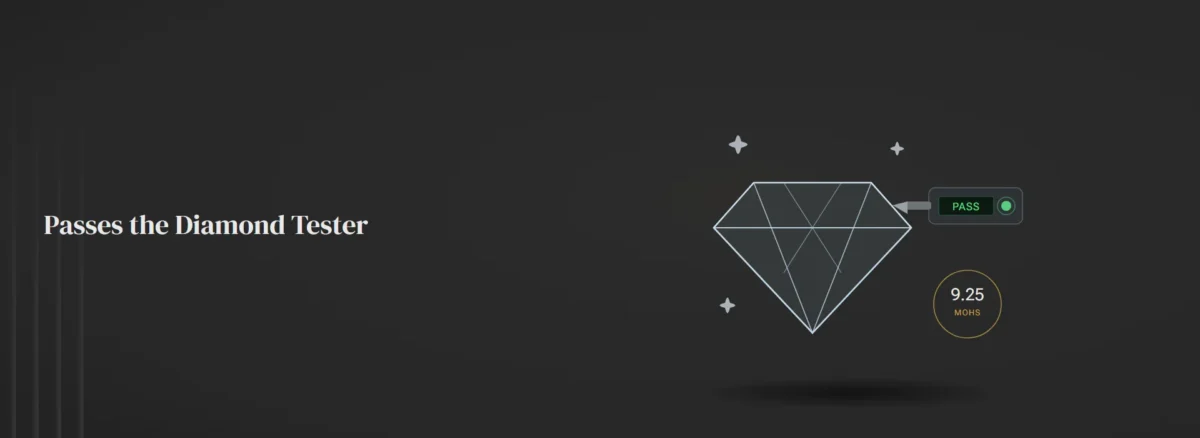
Passes the Diamond Tester
Watch our moissanite register as diamond on a standard tester - and understand exactly what that result proves.
Quick Facts
One of the most common questions we’re asked is whether Kloira’s moissanite stones will register as diamond on a handheld diamond tester. The short answer is yes — and the video below shows it happening on one of our pieces. This guide explains what the test actually measures, why moissanite passes it, and what the result does and does not prove.
Diamond tester demonstration. A standard thermal-conductivity diamond tester applied to a Kloira moissanite piece, registering a positive diamond reading.
How a Diamond Tester Works
The handheld testers used in most jewellery shops are thermal conductivity probes. They press a heated tip against the stone and measure how quickly heat is drawn away from it. Diamond conducts heat exceptionally well — better than almost any other material — so a stone that pulls heat away rapidly is reported as diamond.
This is what makes the test useful: for decades, the materials commonly passed off as diamond — cubic zirconia, glass, white sapphire — are all poor thermal conductors and fail immediately. A thermal tester separates diamond from those substitutes reliably and in about a second.
Why Moissanite Passes
Moissanite is silicon carbide, and it happens to conduct heat at a rate close enough to diamond that a thermal probe cannot separate the two. That is not a flaw in the stone or a trick — it is a genuine physical property of the material, and it is the reason moissanite behaves like diamond in so many other respects too.
| Property | Diamond | Moissanite | Cubic Zirconia |
|---|---|---|---|
| Mohs hardness | 10 | 9.25 | 8.0–8.5 |
| Refractive index | 2.42 | 2.65 | 2.15 |
| Dispersion (fire) | 0.044 | 0.104 | 0.060 |
| Thermal conductivity | Very high | Very high | Low |
| Passes a thermal tester? | Yes | Yes | No |
Note the dispersion figure. Moissanite’s is more than double that of diamond, which is why it throws noticeably more coloured fire in bright light. On an iced-out piece that extra brilliance is precisely the effect most people are looking for.
What the Test Proves — and What It Doesn’t
We want to be straightforward about this, because it matters more than a marketing claim.
Passing a thermal diamond tester proves the stone is not cubic zirconia, glass, crystal, or any of the cheap simulants that make up the overwhelming majority of fake stones. That is a genuinely meaningful result, and it is the test almost anyone examining your piece will actually run.
It does not prove the stone is a mined diamond, and moissanite is not sold as one. There are dual-probe testers that add an electrical conductivity measurement specifically to tell moissanite and diamond apart, and on those instruments moissanite is correctly identified as moissanite. A trained gemmologist with the right equipment will always be able to distinguish the two.
Moissanite Hardness and Daily Wear
Moissanite rates 9.25 on the Mohs scale, placing it second only to diamond at 10 among materials used in jewellery. In practical terms it resists scratching from virtually everything encountered in daily life, including the quartz dust that accounts for most abrasion on softer stones.
That hardness is why moissanite suits pieces meant to be worn constantly rather than kept for occasions. A stone rated 8 or below will visibly dull over a few years of daily wear; moissanite will not.
Why Choose Moissanite
- Brilliance. Higher refractive index and more than double the dispersion of diamond, giving noticeably more fire.
- Durability. 9.25 on the Mohs scale — built for everyday wear.
- Value. A dramatically larger stone, or a fully iced-out piece, for a fraction of the equivalent diamond cost.
- Origin. Lab-created, so the supply chain is traceable and free of the sourcing questions that surround mined stones.
- Consistency. Lab conditions produce reliable clarity and colour across a whole setting, which matters enormously on a piece using hundreds of stones.
Caring for Moissanite
Clean with mild soap and warm water using a soft brush, working around the settings where residue collects and dulls the stones faster than anything else. Rinse and dry thoroughly. Avoid harsh chemicals, and keep pieces away from chlorine, which attacks the metal of the setting rather than the stone itself.
Have the settings checked periodically. On any stone-set piece, a stone that has begun to work loose is far cheaper to re-set than to replace once lost.
Common Misconceptions
- “Passing a tester means it is a diamond.” It means the stone conducts heat like diamond. That rules out cubic zirconia and glass; it does not make the stone a mined diamond.
- “Moissanite is just cubic zirconia.” They are unrelated materials. Moissanite is silicon carbide at 9.25 Mohs; CZ is around 8 and fails a thermal tester outright.
- “Moissanite loses its sparkle.” It does not. Brilliance is a property of the material and the cut, neither of which degrades. Dullness is surface residue, and it cleans off.
- “No one can tell the difference.” A gemmologist with a dual-probe tester or a loupe can. The relevant point is that moissanite stands on its own merits, not that it hides.
- “Lab-created means lower quality.” Lab conditions give more consistent clarity and colour than mined supply, which is an advantage on any piece using large numbers of matched stones.
Frequently Asked Questions
Yes. Standard handheld diamond testers measure thermal conductivity, and moissanite conducts heat at a rate close enough to diamond that the probe cannot separate them. The video on this page shows the test being performed on one of our pieces.
Most handheld testers measure thermal conductivity - how quickly a stone draws heat away from a warmed probe tip. Diamond conducts heat exceptionally well, so a rapid reading is reported as diamond. Cubic zirconia, glass and white sapphire all conduct heat poorly and fail immediately.
No, and we do not sell it as one. Passing proves the stone is not cubic zirconia, glass or another cheap simulant, which is a meaningful result. Moissanite is silicon carbide - a gemstone in its own right, with more fire than diamond and slightly less hardness.
Yes. Dual-probe testers add an electrical conductivity measurement specifically to separate the two, and on those instruments moissanite is correctly identified as moissanite. A trained gemmologist with the right equipment can always tell the difference.
Moissanite rates 9.25 on the Mohs scale against diamond at 10, making it the second hardest material commonly used in jewellery. In practice it resists scratching from virtually everything encountered in daily wear, including airborne quartz dust.
No. Brilliance comes from the refractive index of the material and the quality of the cut, neither of which degrades. A moissanite piece that looks dull almost always has surface residue around the settings, and it cleans off.
Its dispersion - the measure of how strongly a stone splits light into colours - is 0.104, more than double diamond’s 0.044. That is why moissanite throws noticeably more coloured fire, an effect that suits iced-out pieces particularly well.
Yes. Our moissanite is lab-created, which gives a fully traceable supply chain and far more consistent clarity and colour than mined supply. On a piece using hundreds of matched stones, that consistency matters more than the grade of any single stone.
Use mild soap and warm water with a soft brush, working carefully around the settings where residue collects. Rinse and dry thoroughly. Avoid harsh chemicals, and keep pieces away from chlorine, which attacks the metal of the setting rather than the stone.
It is one of the best. At 9.25 Mohs it withstands daily wear without dulling, unlike softer stones rated 8 or below which visibly abrade within a few years. Combined with its brilliance and cost, that durability is why it suits pieces meant to be worn constantly.
Conclusion
A positive reading on a standard diamond tester tells you the stone in your piece is a genuine high-conductivity gemstone rather than a cheap simulant - and that is exactly what it is. Moissanite earns its place on its own properties: harder than almost anything else you could wear, with more fire than diamond, at a price that makes a fully iced-out piece achievable.

Worldwide Delivery
Enjoy complimentary overnight shipping with fast delivery, ensuring convenience and prompt luxury service.
14 Days Returns
Experience peace of mind with our satisfaction guarantee, ensuring premium quality and unmatched customer service.
Lifetime Warranty
Shop with confidence, backed by verified trust ratings, secure transactions, and exceptional quality assurance every time.
24/7 Customer Support
We're here for you anytime, anywhere. Our dedicated customer support team is ready to assist you around the clock.