


Watch Anatomy
Explore the key components that make our diamond-studded timepieces exceptional — and understand the craftsmanship behind every detail.
Quick Facts
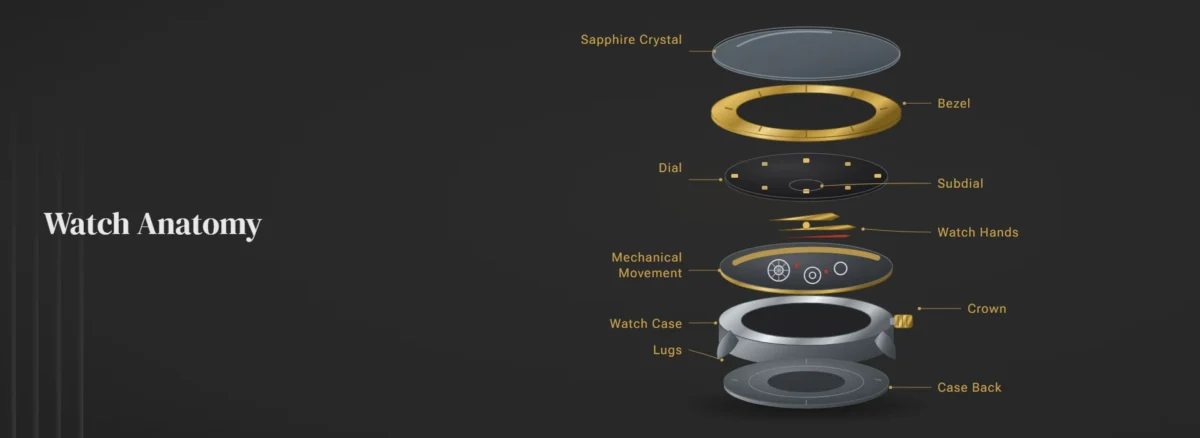
Every luxury timepiece is an assembly of precisely engineered parts, and knowing what each one does changes how you shop. This guide walks through the anatomy of a watch — case, dial, bezel, movement, crown, bracelet and buckle — so you can read a spec sheet with confidence and judge quality for yourself.
The Movement: What Drives the Watch
The movement is the engine of the watch. It is the mechanism that measures time and drives the hands, and it is the single biggest factor in how a watch performs, what it costs, and how you care for it.
Mechanical movements — whether manual or automatic — run on a system of gears and springs with no battery involved. Quartz movements use a battery and a vibrating quartz crystal. Despite quartz being the more accurate technology, collectors consistently prefer mechanical watches for the centuries-old craftsmanship and hand expertise they represent.
Comparing the Three Movement Types
| Movement | Power Source | Typical Accuracy | Best For |
|---|---|---|---|
| Manual | Hand-wound mainspring | Several seconds per day | Traditionalists who enjoy the daily winding ritual |
| Automatic | Wrist motion winds the mainspring | Several seconds per day | Everyday wear with mechanical craftsmanship |
| Quartz | Battery and quartz crystal | A few seconds per month | Maximum accuracy and minimal maintenance |
The Case: Protective Housing for Your Timepiece
The watch case encases and protects the movement from dust, moisture and impact. Beyond protection, it is the element that most defines a watch on the wrist — its shape sets the entire style of the piece.
Case Shapes and What They Signal
| Shape | Character | Why Choose It |
|---|---|---|
| Round | Classic and timeless | Easy readability and a balanced aesthetic; works with every style |
| Rectangle | Sleek and modern | A sophisticated, refined look — ideal for dress watches |
| Square | Bold and distinctive | Makes a statement while staying versatile for casual and formal wear |
| Oval | Elegant and unique | Combines curves and elongation for a comfortable, sophisticated fit |
The Bezel: Functional and Decorative Rims
The bezel is the ring that sits around the crystal. On many luxury and tool watches it is not just decorative — it is an instrument you actively use.
Diving Bezel
A diving bezel lets a diver monitor their air supply by tracking elapsed dive time against minute markers running from 0 to 60. For safety it is unidirectional and rotates only counterclockwise, so an accidental knock can never make a dive appear shorter than it truly is. Before descending, the diver sets the bezel to match the air in their tank.
Timing Bezel
A timing bezel works on the same principle but rotates both clockwise and counterclockwise. That makes it far more versatile for everyday timing tasks — a parking meter, a workout interval, or something on the stove.
The Dial: Elegance and Functionality in Every Detail
The dial is the face of the watch and carries the hour markers and hands that make time readable at a glance. At Kloira our diamond-studded dials are designed to combine beauty with precision. From classic to contemporary styles, each dial is meticulously crafted to ensure clarity, durability and elegance.
Subdials
A subdial is a smaller dial set within the main face, used for additional functions such as chronograph readings, a running seconds hand, or the date. Subdials are what allow a watch to carry extra complications without cluttering the primary time display.
The Crown and Lugs
The crown is used to wind the movement and set functions like the time and date. On water-resistant models it screws down into the case to form a watertight seal, which is a significant part of how the watch keeps moisture out.
The lugs are the extensions that protrude from the watch case to secure the strap or bracelet to the timepiece. Their width determines which straps will fit, and their curvature has a large effect on how the watch sits on your wrist.
Bracelets and Buckles
Our diamond-studded bracelets are designed with exceptional attention to detail, ensuring both comfort and style. From classic metal bands to elegant leather straps, each bracelet is crafted to enhance the beauty and functionality of your timepiece.
Ardillon Buckle
The classic design: one end of the strap threads through a buckle and is secured with a pin, giving an adjustable fit across a range of hole positions.
Deployant Buckle
A leather strap connected to a folding metal buckle, invented in the early twentieth century. It offers meaningfully more safety than a traditional Ardillon buckle — if the buckle springs open, the watch stays attached to your wrist rather than falling.
Water Resistance: How to Gauge Water Protection
Understanding water resistance is one of the most misunderstood parts of watch ownership. In the United States, the Federal Trade Commission does not permit the term “waterproof,” because any watch can leak under the right combination of pressure, temperature and seal wear — though the term is still commonly used elsewhere.
A watch is considered water resistant if it can endure the pressure at 30 meters (99 feet). Resistance is also expressed in atmospheres (ATM), where one ATM equals 10 meters or 33 feet. A watch rated 3 ATM is therefore water resistant to roughly 99 feet.
| Rating | Equivalent Depth | Practical Guidance |
|---|---|---|
| 3 ATM | 30 m / 99 ft | Splashes and rain |
| 5 ATM | 50 m / 165 ft | Brief shallow water contact |
| 10 ATM | 100 m / 330 ft | Swimming and surface water activity |
| 20 ATM | 200 m / 660 ft | Diving-capable territory |
Common Mistakes to Avoid
- Assuming a rating is permanent. Gaskets dry out and compress over the years. A ten-year-old 10 ATM watch that has never been serviced should not be treated as swim-safe.
- Operating the crown while the watch is wet. Unscrewing the crown breaks the watertight seal and creates a direct path for moisture into the movement.
- Assuming quartz means low quality. Quartz is objectively the more accurate technology. Mechanical movements cost more for their craftsmanship and complexity, not their timekeeping precision.
- Ignoring lug width when buying a strap. Lug width is a fixed measurement in millimeters. A strap that is even one millimeter off will either not fit or will sit with visible gaps.
- Rotating a diving bezel the wrong way and expecting it to move. A true diving bezel is unidirectional by design. Resistance in one direction is a safety feature, not a fault.
Frequently Asked Questions
Watches typically feature three main types of movements: manual, automatic, and quartz. Manual movements require daily winding and are known for their traditional craftsmanship. Automatic movements self-wind through the wearer’s wrist motion, offering convenience without daily winding. Quartz movements, powered by a battery, provide superior accuracy and require minimal maintenance.
The best movement depends on personal preference. Manual movements suit traditionalists who enjoy the daily winding ritual. Automatic movements offer convenience through self-winding. Quartz movements prioritise accuracy and low maintenance.
A self-winding, or automatic, watch movement uses the motion of the wearer’s wrist to wind the mainspring, eliminating the need for manual winding. This type of movement is highly popular in luxury watches for its convenience and precision.
Watches use either mechanical or electronic motion. Mechanical watches operate through gears and springs. Quartz watches use electronic motion, powered by a battery and a quartz crystal.
Choosing a watch movement means weighing your lifestyle against your preferences, with options ranging from traditional manual, to convenient automatic, to highly precise quartz.
Quartz movements are the most accurate, powered by a battery and a vibrating quartz crystal. They lose or gain only a few seconds per month. Mechanical movements, both manual and automatic, vary by several seconds per day.
Luxury watches predominantly use mechanical movements, both manual and automatic, for their intricate craftsmanship. High-end brands often develop in-house movements, ensuring exclusivity and superior quality.
It depends on what you value. Quartz offers accuracy and low maintenance. Automatic offers traditional mechanical appeal and craftsmanship.
Mechanical movements, both manual and automatic, are generally more expensive than quartz movements because of their intricate craftsmanship and complex engineering.
Look at the seconds hand: an automatic sweeps smoothly, unlike the distinct tick of a quartz watch. Check whether the watch self-winds with wrist motion. Many automatic watches also have a transparent case back so you can view the movement.
Conclusion
Once you can name the parts of a watch, every specification sheet becomes readable and every comparison becomes fair. You will know why one movement costs more than another, what a bezel is actually for, and how far you can trust a water-resistance rating. That knowledge is what separates buying a watch from genuinely choosing one — and it is the foundation for appreciating the craftsmanship in every Kloira timepiece.



Worldwide Delivery
Enjoy complimentary overnight shipping with fast delivery, ensuring convenience and prompt luxury service.
14 Days Returns
Experience peace of mind with our satisfaction guarantee, ensuring premium quality and unmatched customer service.
Lifetime Warranty
Shop with confidence, backed by verified trust ratings, secure transactions, and exceptional quality assurance every time.
24/7 Customer Support
We're here for you anytime, anywhere. Our dedicated customer support team is ready to assist you around the clock.