

Watch Bracelets
From the Oyster to the Oysterflex — how each bracelet style is built, what it is made of, and which one suits your wrist.
Quick Facts
A watch bracelet is more than a functional strap. It carries the weight of the watch, decides how the piece sits on your wrist, and does as much as the dial to set the character of the timepiece. This guide covers the five bracelet styles you will meet most often, the materials they are made from, and how to choose between them.
The Main Bracelet Styles
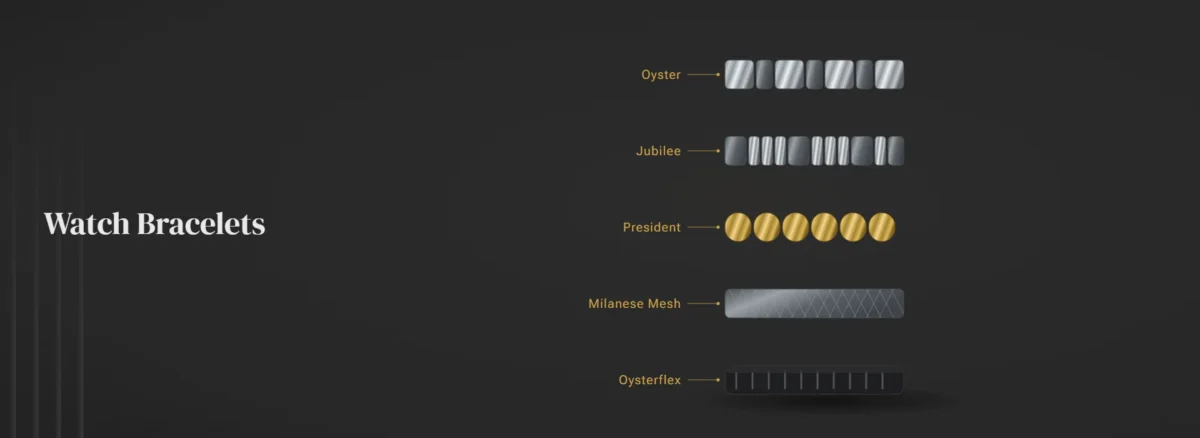
Watch bracelets come in several distinct styles, each with a different look and feel. The Oyster is prized for durability, the Jubilee for elegance, the President for luxury, the Milanese mesh for its sleek flexibility, and the integrated bracelet for the way it disappears into the watch case.
| Bracelet | Construction | Introduced | Best Known For |
|---|---|---|---|
| Oyster | Three-piece flat links | 20th century | Strength and everyday durability |
| Jubilee | Five-piece links | 1945 | Dressy comfort and a refined drape |
| President | Three-piece semi-circular links | 1956 | Precious-metal luxury |
| Milanese Mesh | Woven mesh | 19th century origins | Flexibility and a vintage look |
| Oysterflex | Metal blades in elastomer | 2015 | Rubber comfort with metal rigidity |
Oyster Bracelet
The Oyster is one of the most recognisable metal bracelets ever made. Over the decades its design has evolved to use solid links and a robust clasp, giving better durability and a more secure fit.
What makes it endure is the signature central bar, which reinforces the links and minimises stretching over time. That resistance to stretch is the practical reason collectors trust it for daily wear. Its sleek but sturdy proportions let it pair with everything from dive watches to dress pieces.
Jubilee Bracelet
Introduced in 1945 for the launch of the Datejust, the Jubilee uses a five-piece link construction: three narrow polished centre links flanked by two broader brushed outer links. That mix of finishes is what gives it its distinctive glitter at a distance.
The many small links let it conform closely to the wrist, so it feels lighter and smoother than its weight suggests. A hidden Crownclasp or Oysterclasp keeps the line of the bracelet unbroken.
President Bracelet
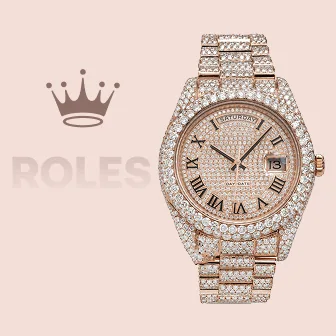
First introduced in 1956, the President is built from three-piece semi-circular links, a profile that sits softly against the wrist. It is made only in precious metals — typically gold or platinum — with polished centre links against brushed outer links.
A concealed Crownclasp preserves the smooth, unbroken look while providing a secure closure. It remains one of the most immediately recognisable signals of a high-end watch.
Integrated Bracelet
An integrated bracelet is designed as part of the watch case itself, with no traditional lugs — the case flows directly into the first link. The result is a single continuous form rather than a watch with a strap attached.
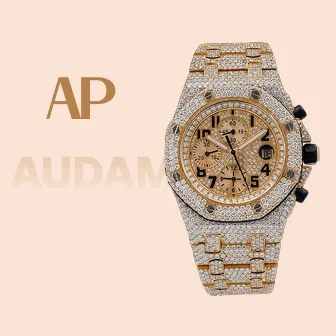
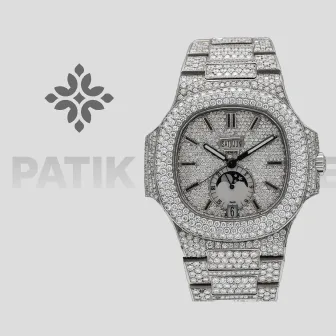
The definitive example is Gérald Genta’s 1972 design for the AP Royal Oak: a tapered bracelet of large single links joined by two rows of studs, alternating brushed and polished surfaces. In 1976 Genta refined the idea for the Patek Philippe Nautilus, using H-shaped links flanking larger central links. Those two designs shaped the entire sport-luxury category that followed, from the Vacheron Constantin Overseas to the Girard-Perregaux Laureato.
Oysterflex Bracelet
Introduced in 2015, the Oysterflex pairs the comfort of rubber with the rigidity of metal. Titanium and nickel-alloy blades are encased in black elastomer, with a patented longitudinal cushion system underneath that holds the watch stable on the wrist.
Because the metal core carries the load, it resists the deformation and sag that afflict ordinary rubber straps over time. It first appeared on a Rolex in Everose gold and remains exclusive to that maker.
Bracelet Materials
The material sets the durability, the weight and much of the cost. Stainless steel is the most common choice for good reason — strong, corrosion-resistant and comparatively affordable. Titanium is lighter than steel yet comparably strong, which suits larger sports watches. Gold and platinum carry the most prestige but are softer, so they mark more easily and need more care.
| Material | Relative Weight | Durability | Notes |
|---|---|---|---|
| Stainless steel | Medium | High | The default: strong, corrosion-resistant, easy to refinish |
| Titanium | Light | High | About 40% lighter than steel; hypoallergenic |
| Gold | Heavy | Moderate | Softer than steel, so it scratches more readily |
| Platinum | Very heavy | Moderate | Dense and prestigious; develops a patina with wear |
| Two-tone | Medium-heavy | High | Gold and steel combined for luxury with resilience |
| Elastomer core | Light | High | Rubber feel, metal rigidity; suits water and sport |
Common Mistakes to Avoid
- Choosing a bracelet by looks alone. Weight and drape matter more day to day. A solid gold bracelet looks superb and wears heavy — try one on before committing.
- Ignoring the clasp. A concealed clasp keeps the bracelet’s line unbroken but usually offers less on-the-fly adjustment than a visible one with an extension system.
- Over-tightening a mesh bracelet. Milanese mesh conforms so readily that it is easy to fasten it too tight without noticing until it marks the skin.
- Assuming any strap will fit. Lug width is a fixed measurement in millimetres, and an integrated bracelet cannot be swapped for a standard strap at all — the case has no lugs to attach one to.
- Cleaning precious metal like steel. Gold and platinum are softer. A brush stiff enough for a steel Oyster will leave visible marks on a President.
Frequently Asked Questions
An Oyster uses three broad flat links and is built for durability, giving a sportier look. A Jubilee uses five links per row, with three narrow polished centre links between two brushed outer links. The Jubilee is dressier and drapes more closely to the wrist; the Oyster is more robust for daily wear.
Comfort depends on wrist shape, but bracelets with more, smaller links generally conform better. The Jubilee and Milanese mesh are usually rated most comfortable because they flex closely around the wrist. Weight also matters: a titanium bracelet is noticeably easier to wear all day than solid gold.
An integrated bracelet is designed as part of the watch case, with no traditional lugs — the case flows directly into the first link. Gérald Genta popularised the design with the AP Royal Oak in 1972 and the Patek Philippe Nautilus in 1976. Because there are no lugs, an integrated bracelet cannot be swapped for a standard strap.
On a watch with conventional lugs, yes — you need a spring bar tool and the correct lug width in millimetres. Screw-in bars need a matching screwdriver. Integrated bracelets generally cannot be replaced with standard straps, since the case has no lugs to attach one to.
The Oysterflex uses titanium and nickel-alloy blades encased in black elastomer. That metal core gives it the rigidity of a bracelet with the comfort and water tolerance of a rubber strap, and it resists the sagging that affects ordinary rubber over time. It was introduced in 2015 and remains exclusive to Rolex.
Measure the gap between the lugs in millimetres — that is the lug width, and it is a fixed dimension. Common sizes are 18mm, 20mm and 22mm. A strap even one millimetre off will either not fit or will leave visible gaps at the case.
Stainless steel and titanium are the most durable in everyday use. Both resist corrosion and hold their finish well, and steel can be refinished to remove accumulated scratches. Gold and platinum are more prestigious but softer, so they mark more readily.
Use warm water with a little mild soap and a soft brush, working between the links where residue collects. Rinse and dry thoroughly, especially around the clasp. Be gentler with precious metals than with steel, and avoid ultrasonic cleaners on any bracelet set with stones.
Wrists swell slightly through the day, particularly in warm weather. Size a bracelet at the end of the day rather than first thing in the morning, and use the micro-adjustment holes in the clasp if your watch offers them.
A concealed clasp — such as a Crownclasp — hides the opening mechanism inside the bracelet so the links appear continuous. It looks cleaner than a visible folding clasp but usually offers less on-the-fly adjustment.
Conclusion
The bracelet decides how a watch actually feels to wear, which is why two watches with identical movements can suit two very different owners. Match the style to your wrist and the material to your week, and the piece will be worn rather than admired in a drawer.
Worldwide Delivery
Enjoy complimentary overnight shipping with fast delivery, ensuring convenience and prompt luxury service.
14 Days Returns
Experience peace of mind with our satisfaction guarantee, ensuring premium quality and unmatched customer service.
Lifetime Warranty
Shop with confidence, backed by verified trust ratings, secure transactions, and exceptional quality assurance every time.
24/7 Customer Support
We're here for you anytime, anywhere. Our dedicated customer support team is ready to assist you around the clock.