


Watch Complications
Chronographs, calendars, moon phases and tourbillons — what each complication does, and which are genuinely worth having.
Quick Facts
In watchmaking, a complication is any function a watch performs beyond telling the hours, minutes and seconds. Complications are where mechanical watchmaking shows its ambition — and where the price of a timepiece can multiply several times over. This guide explains the main ones, what they do, and which are genuinely useful.
What Counts as a Complication
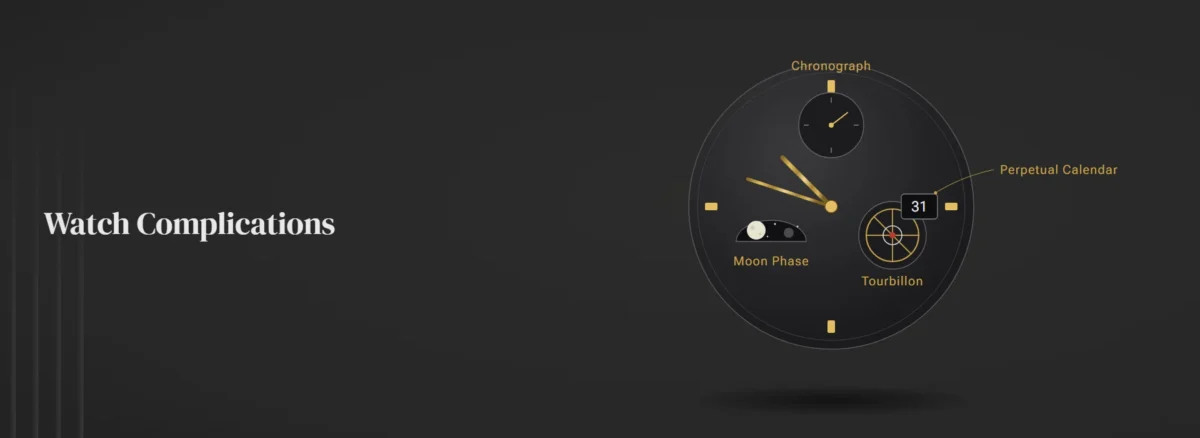
At Kloira, a watch is more than a timepiece — it is a work of art and a demonstration of engineering. Our collection features watches with a range of complications, from chronographs and moon phases to tourbillons and perpetual calendars, each adding a layer of both sophistication and function.
Every complication adds parts, and every added part adds friction, servicing cost and potential failure points. That is the honest trade behind the romance: a simple three-hand watch is the most reliable watch, and everything beyond it buys capability at the cost of complexity.
| Complication | What It Does | Complexity | Everyday Usefulness |
|---|---|---|---|
| Date | Displays the day of the month | Low | High |
| Chronograph | Stopwatch function | Moderate | High |
| GMT / dual time | Tracks a second time zone | Moderate | High for travellers |
| Annual calendar | Auto-adjusts all months except February | High | Moderate |
| Moon phase | Shows the lunar cycle | Moderate | Low — decorative |
| Perpetual calendar | Handles leap years to 2100 | Very high | Moderate |
| Minute repeater | Chimes the time on demand | Extreme | Low — a showpiece |
| Tourbillon | Rotating escapement cage | Extreme | Low — see below |
The Chronograph
A chronograph combines normal timekeeping with a stopwatch. Pushers on the side of the case start, stop and reset the timer, while sub-dials record elapsed seconds, minutes and sometimes hours. It is the most practically useful of the classic complications, and historically the one tied to aviation, motorsport and athletic timing.
Chronographs vary considerably in construction. A column-wheel chronograph gives a smoother, more positive pusher feel than the cam-actuated alternative, which is one of the details that separates movements at different price points.
Calendar Complications
A simple date window needs manual correction five times a year, in every month shorter than thirty-one days. An annual calendar knows the length of every month except February, so it needs correcting once a year. A perpetual calendar accounts for leap years too and will not need adjustment until 2100, when the Gregorian calendar skips a leap year that the mechanism cannot anticipate.
The Moon Phase
A moon phase display tracks the lunar cycle through an aperture in the dial, usually driven by a disc bearing two moons. The true lunar month is about 29.53 days, so a standard 59-tooth mechanism drifts by roughly one day every two and a half years. High-precision versions reduce that error to a day in more than a century.
It is the least practical complication on this list and one of the most enduringly popular, which tells you something about why people buy mechanical watches at all.
The Tourbillon
The tourbillon places the escapement and balance wheel inside a rotating cage. As the cage turns, positional errors caused by gravity acting on the balance spring average out over each rotation.
It was invented in 1801, when watches were carried in pockets and therefore spent long periods in a single vertical orientation. On a wristwatch, which changes position constantly through the day, that averaging happens naturally — so the practical accuracy benefit is largely absent. The tourbillon survives as a demonstration of watchmaking skill and as visual theatre through a dial aperture, not as a precision aid.
Common Mistakes to Avoid
- Believing a tourbillon makes a wristwatch more accurate. It was designed for pocket watches held in one position. On the wrist the benefit is mostly theoretical.
- Adjusting the date inside the danger window. Between about 9pm and 3am the mechanism is already engaged. Advance the time to midday first, then set the date.
- Buying complications you will never use. Every added function raises the service cost and adds failure points. A chronograph you use beats a perpetual calendar you do not.
- Letting a complicated watch stop. Restarting a perpetual calendar correctly is a real task, not a quick crown adjustment.
- Assuming more complications means better timekeeping. They are independent. A simple three-hand watch is often the most accurate and the most reliable piece in a collection.
Frequently Asked Questions
A complication is any function a watch performs beyond displaying hours, minutes and seconds. That covers everything from a simple date window to a perpetual calendar or minute repeater. Each added complication increases the number of parts, and with it the servicing cost.
A chronograph combines normal timekeeping with a stopwatch. Pushers on the side of the case start, stop and reset the timer, while subdials record elapsed seconds, minutes and sometimes hours. Chronographs are widely used for athletic timing, aviation and motorsport.
A tourbillon places the escapement and balance wheel inside a rotating cage, so positional errors caused by gravity average out over each rotation. It was designed in 1801 for pocket watches held in one position. On a wristwatch, which moves constantly, that benefit is largely theoretical — the tourbillon survives as a demonstration of watchmaking skill.
An annual calendar knows the length of every month except February, so it needs correcting once a year. A perpetual calendar also accounts for leap years and will not need adjustment until 2100, when the Gregorian calendar skips a leap year the mechanism cannot anticipate.
A standard moon phase uses a 59-tooth disc, which drifts by roughly one day every two and a half years against the true lunar month of about 29.53 days. High-precision versions reduce that error to about one day per century.
On most mechanical movements the date change gears begin engaging in the evening and stay engaged until the early hours. Turning the date manually while they are meshed can shear teeth. Advance the hands to midday first, then set the date safely.
A GMT adds a second hour hand, usually reading against a 24-hour scale, to track an additional time zone. It is one of the most genuinely practical complications for anyone who travels or works across time zones.
Not directly, but they add parts and friction, which can affect a movement’s rate and increase what it costs to keep running well. A simple three-hand watch is often the most reliable and accurate piece in a collection.
A minute repeater chimes the current time on demand using small hammers and gongs inside the case. It originated before electric light, when a watch could be read in the dark only by sound. It is among the most complex and expensive complications to make.
It depends entirely on whether you will use them. A chronograph or GMT earns its keep for many owners. A perpetual calendar or tourbillon is bought for craftsmanship rather than utility, and both carry considerably higher service costs for the life of the watch.
Conclusion
Complications are where watchmaking stops being practical and starts being remarkable. Buy the ones you will genuinely use, understand what the rest actually do before paying for them, and budget for the servicing that complexity brings.





Worldwide Delivery
Enjoy complimentary overnight shipping with fast delivery, ensuring convenience and prompt luxury service.
14 Days Returns
Experience peace of mind with our satisfaction guarantee, ensuring premium quality and unmatched customer service.
Lifetime Warranty
Shop with confidence, backed by verified trust ratings, secure transactions, and exceptional quality assurance every time.
24/7 Customer Support
We're here for you anytime, anywhere. Our dedicated customer support team is ready to assist you around the clock.