


The Art of Timepieces
Your starting point for understanding luxury watches — how they work, what separates them, and where to read further.
Quick Facts
Welcome to the Kloira Watch Education Center. Whether you are buying your first luxury timepiece or adding to an established collection, this guide is the starting point — an overview of how a watch works, what separates one from another, and where to read further on each subject.
Why Understanding Watches Matters
A luxury watch is one of the few objects where the price range for something that performs the same basic task spans several orders of magnitude. A quartz watch costing very little will keep better time than a mechanical watch costing a hundred times more. Understanding why that is true — and why people still choose the mechanical one — is the difference between buying a watch and choosing one.
What you are paying for in a fine timepiece is craftsmanship, materials, finishing and the engineering tradition behind the movement. None of those show up in a timekeeping test. All of them show up in the hand.
The Six Areas Worth Knowing
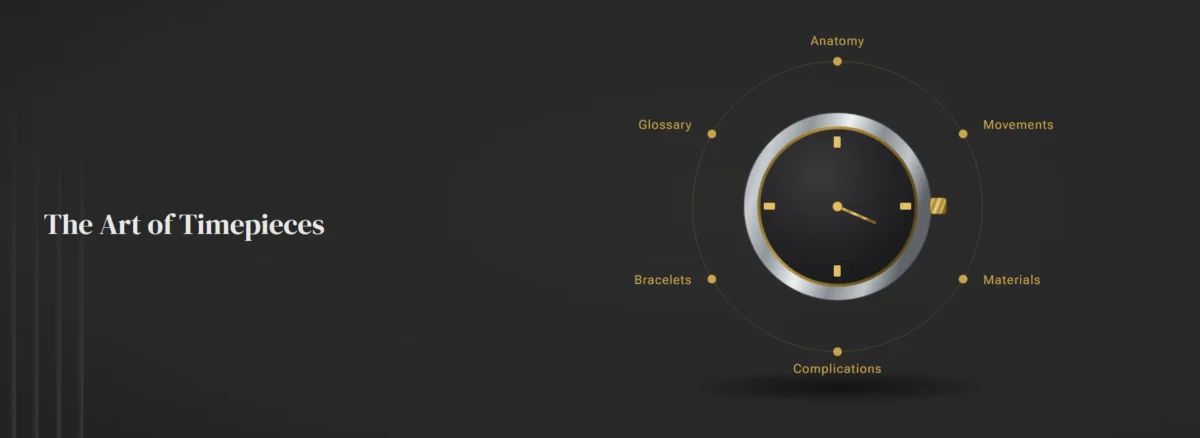
| Topic | What It Covers | Why It Matters |
|---|---|---|
| Anatomy | Case, dial, crown, lugs, bezel, movement | Lets you read any specification sheet |
| Movements | Manual, automatic and quartz | The single biggest factor in price and upkeep |
| Complications | Chronographs, calendars, tourbillons | Decides what a watch does beyond the time |
| Materials | Steel, gold, titanium, ceramic, sapphire | Governs weight, durability and care |
| Bracelets | Oyster, Jubilee, President, mesh, integrated | Determines comfort and daily wearability |
| Water resistance | ATM ratings, gaskets, real-world limits | Prevents the most common cause of damage |
Start With the Anatomy
Every specification sheet assumes you know the parts. The case houses and protects the movement. The dial carries the markers and hands. The crown winds the watch and sets the time. The lugs hold the strap, and their width dictates every strap that will ever fit. The bezel surrounds the crystal and, on many watches, is an instrument in its own right.
Learn those six words and most watch descriptions become readable immediately.
Then Understand the Movement
Three types cover nearly everything. Manual movements are wound by hand each day and represent the oldest tradition. Automatic movements wind themselves from the motion of your wrist. Quartz movements run on a battery and are the most accurate of the three by a wide margin.
Mechanical movements cost more than quartz because of the craftsmanship and the number of hand-finished components, not because they keep better time.
Match the Watch to How You Live
The most useful question is not which watch is best, but which watch suits your week. Someone who swims regularly needs 10 ATM and a screw-down crown far more than a tourbillon. Someone wearing a watch to an office every day may value a slim case and a comfortable bracelet above a dive rating they will never use.
Set a budget, decide what the watch actually needs to survive, and let the specifications follow from that.
Common Mistakes New Buyers Make
- Buying case size from a photograph. A 42mm case looks moderate online and can overwhelm a slimmer wrist. Try before committing where you can.
- Paying for complications you will not use. Every added function raises the service cost and adds failure points.
- Trusting the water resistance number. A 50 m rating is not a swimming rating, and it degrades as gaskets age.
- Assuming mechanical means accurate. Quartz wins on precision every time. Mechanical wins on everything else you might care about.
- Ignoring the bracelet. It is half the contact your body has with the watch and does more for comfort than any specification on the dial.
Where to Go Next
Each subject above has a full guide of its own. Start with anatomy if you are new — it makes everything else easier to read. Start with movements if you already know the parts and are trying to choose between watches. The related resources below link to all of them.
Frequently Asked Questions
Start with watch anatomy. Once you know what the case, dial, crown, lugs and bezel are, every specification sheet and review becomes readable. Movements are the natural second step, since they drive most of the price difference between watches.
Prioritise how it wears over what it lists. Case size, weight and bracelet comfort determine whether a watch actually gets worn. Then match the water resistance to your life, and set a budget that includes servicing rather than just the purchase.
Mechanical watches need servicing roughly every five to seven years. Complicated movements such as chronographs and perpetual calendars cost considerably more to service than simple time-only watches. Quartz watches mainly need battery changes, ideally with a gasket replacement and pressure test.
No. An inexpensive quartz watch will usually out-perform a costly mechanical one on pure accuracy. Price in fine watchmaking reflects craftsmanship, materials, finishing and movement complexity, not timekeeping precision.
It depends on your wrist and how the lugs sit rather than the diameter alone. A 42mm case with long lugs can overhang a wrist that carries a 44mm case with short lugs comfortably. Where possible, try before buying — photographs are misleading on size.
Choose quartz for accuracy, low maintenance and lower cost. Choose mechanical for craftsmanship, heritage and the experience of owning something built from hundreds of finished parts. Many collections eventually contain both, for different occasions.
Some models from established makers hold value well, but most watches depreciate like any other purchase. Buy a watch because you want to wear it. Treating one primarily as an investment is a specialised activity with real risk.
Buy from an authorised dealer or a reputable specialist, and insist on the paperwork. On the watch itself, check the finishing quality, the movement through the case back where visible, and the serial and reference numbers against the manufacturer’s records.
For most people, a date or a GMT. Both get used regularly. A chronograph earns its place if you actually time things. Complications bought purely for prestige add servicing cost for functions that go unused.
Keep it dry, away from direct sunlight and away from strong magnets. A watch box or soft pouch is sufficient for most pieces. A winder is worth considering for an automatic with a complicated calendar, where resetting after a stop is genuinely involved.
Conclusion
Understanding watches turns a confusing market into a set of clear choices. Learn the anatomy, understand the movements, and decide what you actually need a watch to do — everything after that is a matter of taste, and taste is the part that should be yours alone.

Worldwide Delivery
Enjoy complimentary overnight shipping with fast delivery, ensuring convenience and prompt luxury service.
14 Days Returns
Experience peace of mind with our satisfaction guarantee, ensuring premium quality and unmatched customer service.
Lifetime Warranty
Shop with confidence, backed by verified trust ratings, secure transactions, and exceptional quality assurance every time.
24/7 Customer Support
We're here for you anytime, anywhere. Our dedicated customer support team is ready to assist you around the clock.