


Water Resistance
What ATM ratings really mean, why no watch is waterproof, and how to keep your timepiece sealed for the long term.
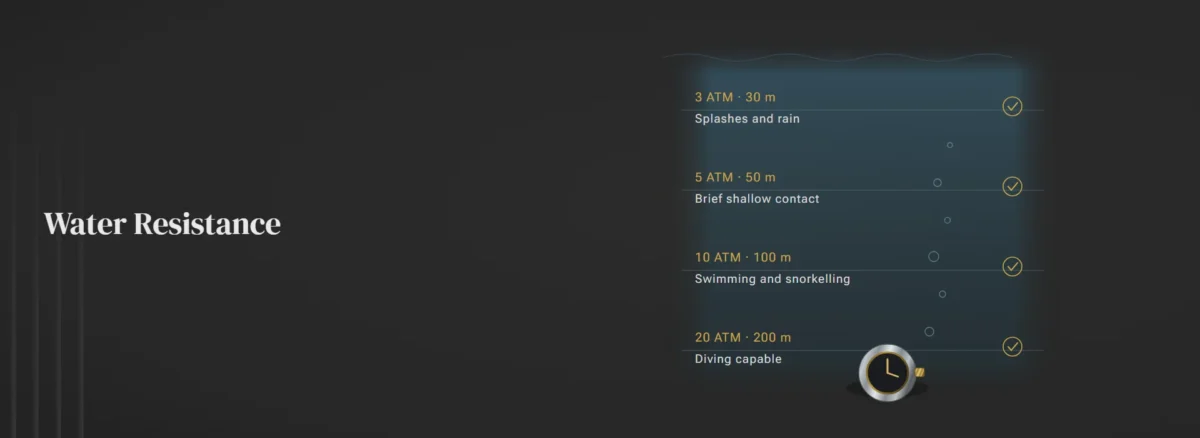
Quick Facts
Water resistance is one of the most misread specifications in watchmaking. A watch marked “50 metres” is not safe at fifty metres of depth, and the reasons why matter if you intend to wear your watch anywhere near water. This guide explains what the ratings mean, what they do not mean, and how to keep them.
What the Ratings Actually Mean
Water resistance describes a watch’s ability to withstand moisture and pressure within defined limits. It is expressed in metres, feet, or atmospheres — where one atmosphere (ATM, also written as bar) equals 10 metres or roughly 33 feet of static pressure.
The critical point is that these figures come from laboratory testing under static pressure on a new watch. Real water is not static. Swimming, diving into a pool, or even moving your arm underwater generates pressure spikes well above the depth alone, which is why the usable depth is always considerably less than the number printed on the dial.
| Rating | Depth | Safe For | Not Safe For |
|---|---|---|---|
| 3 ATM | 30 m / 99 ft | Rain, handwashing, splashes | Swimming, showering |
| 5 ATM | 50 m / 165 ft | Brief shallow contact | Swimming laps, diving |
| 10 ATM | 100 m / 330 ft | Swimming, snorkelling | Scuba diving |
| 20 ATM | 200 m / 660 ft | Recreational scuba diving | Saturation diving |
Water Resistant Is Not Waterproof
In the United States, the Federal Trade Commission does not permit watches to be marketed as “waterproof,” because no watch is genuinely impervious to water under all conditions. The term is still used informally elsewhere, but the underlying fact holds everywhere: every watch has a limit, and that limit moves over time.
Even professional dive watches rated beyond 200 metres have boundaries, and they hold those boundaries only while their seals remain intact.
How a Watch Keeps Water Out
Three components do the work. Gaskets — rubber or synthetic O-rings at the crown, case back and crystal — form the actual seals. A screw-down crown threads into the case rather than merely pushing in, compressing a gasket to close the single most vulnerable opening. A sealed case back, either screwed or pressure-fitted against a gasket, closes the rear.
All three depend on rubber, and rubber ages. Gaskets dry out, compress and lose elasticity whether the watch is worn or not, which is why water resistance is a maintenance item rather than a permanent property.
What Degrades Water Resistance
- Age. Gaskets harden and shrink over years regardless of use.
- Heat. Hot showers, saunas and direct sun expand the case and seals at different rates, breaking the seal temporarily.
- Soap and chemicals. Detergents, chlorine and solvents attack rubber compounds directly.
- Impact. A knock hard enough to mark the case can deform the seating a gasket sits against.
- Crown misuse. Leaving a screw-down crown unsecured removes the primary seal entirely.
Testing and Maintenance
Water resistance can be tested without opening the watch, using dry pressure testing, and confirmed with a wet test. Any competent watchmaker can do this in minutes.
Have seals tested annually if you swim with the watch, and have gaskets replaced whenever the watch is opened for service or a battery change. A battery change is the most common moment for water resistance to be quietly lost — the back comes off, and unless the gasket is replaced and the watch re-tested, it goes back on without its original seal.
Swiss and Japanese Approaches
Swiss manufacturers typically emphasise high-grade gaskets, precise case machining and demanding test protocols, often with features like helium escape valves for saturation diving. Japanese makers such as Seiko and Citizen deliver dependable sealing across a wide price range, with ISO-certified professional dive models at the upper end.
Both approaches produce reliable watches. The meaningful difference is usually price and finishing rather than whether the watch keeps water out.
Common Mistakes to Avoid
- Reading the rating as a diving depth. A 50 m watch is not for swimming. Static laboratory pressure and real movement in water are different things.
- Assuming the rating is permanent. A ten-year-old watch that has never been serviced should be treated as having no reliable water resistance until tested.
- Wearing a watch in the shower. Steam and heat defeat seals that would hold against a swimming pool.
- Skipping the re-test after a battery change. Opening the case back breaks the seal. Without a new gasket and a pressure test, resistance is unverified.
- Forgetting the crown. An unscrewed screw-down crown removes the main seal — the most common cause of water damage, and entirely preventable.
Frequently Asked Questions
It is not advisable. Ratings are measured under static laboratory pressure on a new watch, while swimming generates pressure spikes well above the depth alone. For regular swimming, look for 10 ATM (100 m) or better, with a screw-down crown.
Because every watch depends on rubber gaskets that age, compress and lose elasticity over time. In the United States the Federal Trade Commission does not permit the term "waterproof" for exactly this reason — every watch has a limit, and that limit moves.
Preferably not, regardless of the rating. Steam consists of water molecules small enough to pass gaskets that would stop liquid water, and hot water expands the case and seals at different rates. Soap and shampoo also attack the rubber compounds directly.
Annually if you swim with the watch, and always after the case has been opened for a service or battery change. Testing is quick, non-destructive and inexpensive — any competent watchmaker can pressure test a watch without opening it.
ATM stands for atmospheres of pressure, sometimes written as bar. One ATM equals 10 metres or roughly 33 feet of static water pressure. A 3 ATM watch is therefore rated to about 30 metres under laboratory conditions.
Yes. Gaskets dry out and compress whether the watch is worn or not, and heat, soap, chemicals and impact all accelerate that. A ten-year-old watch that has never been serviced should be treated as having no reliable water resistance until it is tested.
Changing a battery means opening the case back, which breaks the seal. Unless the gasket is replaced and the watch is pressure tested afterwards, it goes back together with an unverified seal. This is one of the most common ways water resistance is quietly lost.
A screw-down crown threads into the case, compressing a gasket to seal the watch’s most vulnerable opening. If you intend to swim with a watch, it is close to essential — and it must be fully screwed down before any water contact.
Take it to a watchmaker immediately. Do not wait to see whether it clears. Moisture inside the case corrodes the movement quickly, and the cost of drying and servicing promptly is far lower than the cost of rust damage left to develop.
Not necessarily. Setting stones into the bezel or case involves machining that can compromise how gaskets seat. Treat a customised watch as less water resistant than its original specification until it has been pressure tested.
Conclusion
Water resistance is a maintenance item, not a permanent feature of a watch. Understand what the rating on your dial actually promises, keep the crown screwed down, and have the seals tested — that is most of what stands between a timepiece and the single most common cause of serious damage.






Worldwide Delivery
Enjoy complimentary overnight shipping with fast delivery, ensuring convenience and prompt luxury service.
14 Days Returns
Experience peace of mind with our satisfaction guarantee, ensuring premium quality and unmatched customer service.
Lifetime Warranty
Shop with confidence, backed by verified trust ratings, secure transactions, and exceptional quality assurance every time.
24/7 Customer Support
We're here for you anytime, anywhere. Our dedicated customer support team is ready to assist you around the clock.